
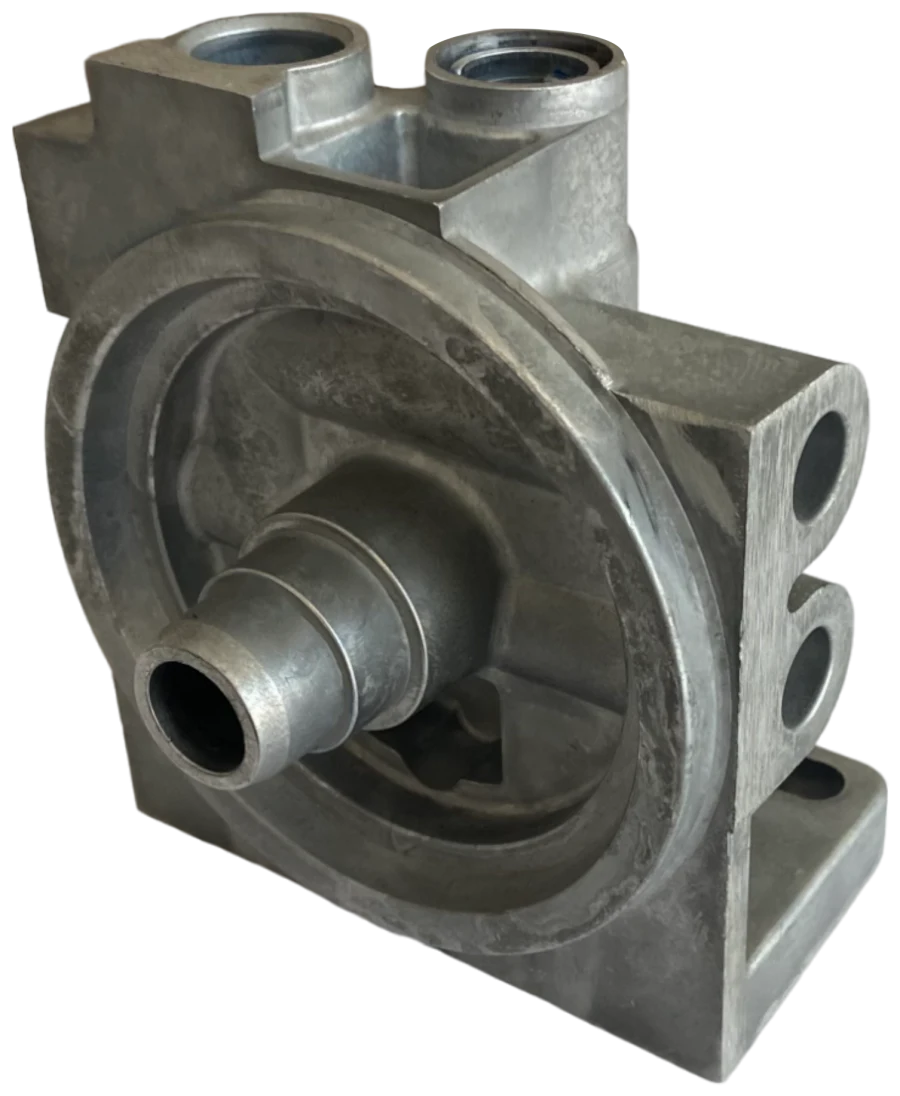
Altınel Kalıp is a mold shop in Konya Karatay that designs and manufactures aluminium injection molds. Known in the industry as aluminium injection mold manufacturing, this work is technically the building of aluminium high-pressure die casting (HPDC) molds: molten aluminium is forced into a steel mold cavity at high speed and pressure, and the part takes shape within seconds.
Aluminium die casting molds are our everyday work, just like plastic injection molds. For manufacturers in Konya's aluminium casting industry, we provide engineering and manufacturing support from a single source, from the first idea for a part to a mold ready for series production.
Aluminium high-pressure die casting is one of the most efficient ways to produce lightweight, strong and thermally conductive parts in series with short cycle times. Much of that efficiency depends on the mold: if the mold is flawed, the same flaw repeats in every cycle. That is why we start by understanding your part and your production expectations, and design the mold around your production conditions.
How does an aluminium injection mold work?
An aluminium die casting mold consists of two halves, a fixed half and a moving half. Production runs in a repeating cycle:
- Mold closing: The moving half closes and is locked with a high clamping force.
- Injection: Molten aluminium is forced into the mold cavity by a piston at high speed and pressure.
- Solidification: The metal solidifies in a controlled manner thanks to the cooling channels.
- Mold opening and ejection: The mold opens, ejector pins push the part out, and the cycle starts again.
Aluminium casting generally uses cold-chamber machines. The metal is melted in a separate furnace, ladled into the shot sleeve in each cycle and pushed into the mold by the piston. This design is the most suitable answer to aluminium's tendency to attack steel injection components.
Cycle time varies with part weight, wall thickness and the cooling layout of the mold. Keeping the mold within the same temperature range in every cycle is critical for consistent part quality.
Alloy selection
The mold design is shaped by the fluidity and shrinkage behavior of the alloy to be used. The general properties of two commonly used alloys are listed below.
| Alloy | General properties | Typical use |
|---|---|---|
| EN AC-46000 (AlSi9Cu3) | Good castability, high strength, suitable for machining | Automotive and machinery housings, covers, brackets |
| EN AC-44300 (AlSi12) | Very good fluidity, thin-wall casting, good corrosion resistance | Thin-walled parts with complex geometry, enclosures |
Ultimately, the choice of alloy depends on the function of the part, its wall thickness and subsequent processing. We evaluate this choice together with you at the quotation stage. If the customer specifies an alloy standard, the mold is designed accordingly, and the shrinkage allowance is also set according to the selected alloy.
What do we focus on in mold design?
A good aluminium die casting mold must produce the part in the drawing without defects, within tolerance and repeatably. The following topics are decisive in the design:
- Runner and gate: The direction and speed at which the metal enters the cavity directly affect fill quality and porosity risk.
- Overflows: They carry cold metal, oxides and air out of the cavity.
- Venting and vacuum: Trapped air causes porosity; suitable venting channels are used and, where necessary, vacuum assistance.
- Cooling and thermal balance: A balanced mold temperature determines distortion, surface defects and cycle time.
- Cores and slides: They make it possible to release undercuts, side holes and mating surfaces from the mold.
- Number of cavities: A single-cavity mold offers flexibility for low quantities and large parts; a multi-cavity mold lowers the unit cost at high quantities. A family mold can also be considered for related parts.
Before making these decisions, we design in a 3D CAD-CAM environment and examine filling and solidification on the computer using moldability and flow/casting simulation. This way, problems are caught before any steel is cut.
Mold steels and heat treatment
Aluminium die casting molds work under high temperatures and thermal shock. For this reason, hot-work tool steels such as 1.2343 and 1.2344 are generally preferred for the mold cavity. During machining, the steel is brought to the required hardness through stress relieving and vacuum heat treatment. In areas exposed to wear and soldering, surface treatments such as nitriding extend mold life. The steel grade and hardness are determined by the part geometry and the expected production quantity.
Heat treatment has a major effect on mold life: steel that is too hard risks cracking, while steel that is too soft risks early wear and thermal fatigue. Preheating the mold before putting it into service and regular maintenance during operation also delay the formation of cracks.
CNC machining: the mold and the cast part
Mold cavities, cores and slides are machined precisely on CNC machines, with EDM support where needed. We offer the same CNC capability for secondary operations on the cast part as well.
- Machining allowances: Sufficient and balanced allowance is left in the mold on the surfaces to be machined after casting.
- Clamping references: Reference surfaces are planned at the casting stage so that the part can be clamped repeatably on the machine.
- Threads and sealing surfaces: Tapping, countersinking and gasket seating surfaces are machined after casting on parts that must be leak-tight.
Trial casting and sample approval
Once the mold is complete, a trial casting is carried out. The first samples are measured and compared with the drawing visually and dimensionally; if necessary, the mold is corrected. The sample approved by the customer is accepted as the reference for series production. During the trial, we evaluate points such as filling, porosity, surface quality, flash and dimensional deviation together, and we record the casting parameters and mold corrections. Our maintenance and revision support continues after approval. Because mold dimensions and lead times vary with the part, we clarify the maximum part size and delivery time, [PLACEHOLDER], at the quotation stage.
Which industries do we produce for?
- Irrigation and filtration systems
- Automotive supply industry
- Machinery and equipment manufacturers
- Electrical and electronic enclosures
- Lighting fixtures
Our scope of services
- Part design and moldability analysis
- Mold flow and casting simulation
- Aluminium injection mold manufacturing
- CNC machining
- Trial casting and sample approval
- Mold maintenance and revision support
- Plastic injection molds and contract semi-finished part production
Plastic vs. aluminium injection molds
Although both methods work on the injection principle, the material, pressure and temperature conditions are different. The mold steel, cooling and venting approach therefore differ as well. We can evaluate together which method suits your part.
Send us your part drawing or 3D model (STEP, PARASOLID); we will carry out a technical assessment for the aluminium die casting mold and prepare a suitable quotation for you.