
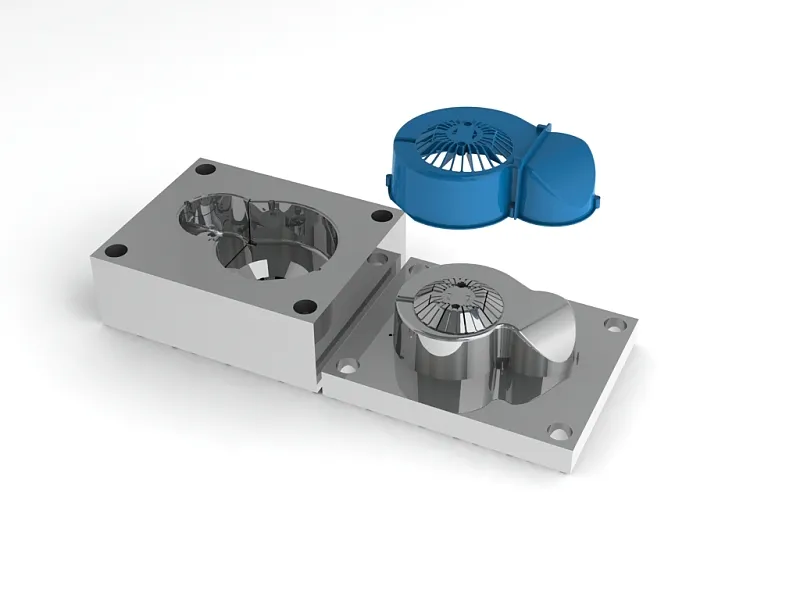
Plastic injection mold manufacturing underpins a modern production method in which plastic raw material is heated until molten, injected under high pressure into a purpose-designed mold, and cooled to form the finished part. It is used across a wide range of industries — from small precision parts and automotive components to electrical and electronic parts, household products and garden furniture.
By combining CAD-CAM and 3D design technologies with CNC machining and precision manufacturing methods, Altınel Kalıp builds custom plastic and aluminium injection molds to meet the needs of diverse industries.
How does a plastic injection mold work?
Plastic raw material in granule form is fed into the hopper of the injection molding machine. Melted by heater bands, the material is injected into the mold under controlled pressure by the screw. The molten plastic fills the mold cavity, is cooled and solidified in a controlled manner, and is then ejected from the mold. The machine essentially consists of three main sections: the clamping unit, the injection unit and the mold.
Production stages
1. Clamping
The clamping unit holds the two halves of the mold together under the required force throughout production. Correct mold closure has a direct impact on the dimensional accuracy and surface quality of the part.
2. Injection
The plastic in the barrel, heated by resistance heater bands, is compressed by the screw, melted under heat and pressure, and delivered into the mold cavity through the nozzle. Injection pressure and speed are controlled according to the material, the mold design and the part geometry.
3. Holding pressure
Pressure is maintained on the molten plastic for a set time to ensure the mold cavity is completely filled. This minimizes sink marks, deformation, warpage and dimensional deviations.
4. Cooling
Controlled cooling is achieved through dedicated water channels inside the mold. A well-designed cooling system shortens cycle time while improving dimensional stability and surface quality.
5. Mold opening and 6. Part ejection
Once cooling is complete, the mold opens and the part is removed by ejector pins, cores or dedicated ejection mechanisms. A properly designed ejection system prevents damage to the part and protects the service life of the mold.
Mold design tailored to you
Every product has its own geometry, dimensions and intended use. That is why product design, mold construction, cooling channels, runner system, cores and ejector systems are all evaluated together. Altınel Kalıp carries out CAD-CAM 3D mold design, CNC machining and precision assembly entirely in-house.
Our scope of services
- Plastic injection mold manufacturing
- Aluminium injection mold manufacturing
- Injection mold design and CAD-CAM 3D modeling
- Mold component manufacturing
- Core and ejector systems
- Mold cooling system design
- Mold maintenance, revision and modification