
Irrigation & Filtration
Irrigation and Filter System Injection Mold Manufacturing
Altınel Kalıp manufactures plastic and aluminium injection molds in Konya, Turkey for irrigation and filter systems, including filter housings, filter heads, fittings, valves and drip irrigation equipment. For parts that must seal under pressure and withstand sunlight and agricultural chemicals, we evaluate the mold and the material together; Valmen Filtre ve Sulama is among our references.
Materials
Irrigation and filtration equipment operates under constant water pressure, exposure to chemicals such as fertilizers and pesticides, sunlight and wide temperature swings. Materials are selected for these conditions:
- UV-stabilized PP and PP GF30: Disc and screen filter housings, covers and fittings; chemical resistance and long outdoor service life.
- PA6/PA66 GF30: High-pressure filter housings, clamps and valve components; rigidity and burst pressure resistance.
- PE (LDPE/HDPE): Drip irrigation emitters, gasket seats and flexible connectors.
- POM: Valve stems, spring seats and moving mechanism parts.
- EN AC-46000 (AlSi9Cu3) and EN AC-44300 (AlSi12): Filter heads and high-pressure housings produced by aluminium injection (die casting); AlSi12 stands out for its good fluidity and pressure tightness.
If PVC fittings are to be produced, stainless mold steels such as 1.2083 or 1.2316 should be used for the cavities because of the corrosive gases that can be released during processing. For aluminium injection molds, 1.2343 hot-work steel (44–48 HRC), which resists thermal fatigue, is preferred.
Mold design
Sealing and pressure resistance are at the heart of mold design for irrigation and filter parts. Details such as threads, seal grooves and weld lines determine whether the part will operate in the field without cracking or leaking.
- Threaded connections: Unscrewing mechanisms or collapsible cores are used for internally and externally threaded housings and caps; two-piece slides are used for large external threads.
- Weld line control: On pressurized housings, gate location is determined by mold flow analysis so that weld lines do not create weak points.
- Cylindrical housings: Center gating (disc or ring gate) and balanced core cooling are used to prevent ovality and wall thickness variation.
- Aluminium injection: To reduce porosity in filter heads, the runner, overflow wells and vacuum/venting channels are designed together; machining allowance is left on seal and threaded areas.
- Multi-cavity molds: Multi-cavity hot runner molds are preferred for high-volume products such as drip irrigation emitters and small fittings.
In disc filters, the groove geometry of the discs directly determines filtration fineness (micron rating), so these mold details are designed with particular precision.
Surface quality
For irrigation and filter parts, surface quality is mostly about function: sealing surfaces, inner surfaces in contact with the fluid, and an exterior that is easy to identify in the field.
- Seal and O-ring surfaces: For reliable sealing, seal grooves must be flash-free and low in roughness; on plastic parts, the mold surface in these areas is polished up to SPI B, while on aluminium housings these areas are finished by machining.
- Outer housings: EDM finishes in the VDI 3400 27–33 range hide the scratches and wear marks that occur in the field.
- Lettering and markings: Markings such as flow direction arrows, pressure ratings and logos are EDM-machined into the mold surface, providing permanent marking that does not wear off outdoors.
- Aluminium die-cast surfaces: The mold surface and casting parameters are adjusted together so that the cast surface is uniform before powder coating or anodizing.
On transparent filter bowls and sight windows, an SPI A2–A3 polish makes contamination on the filter element visible from the outside.
Tolerances
Most tolerances on irrigation and filter parts are connection and sealing dimensions. Pipe threads, seal grooves and clamp fits must also work in the field with products from other manufacturers.
| Criterion | Typical value |
|---|---|
| Cavity and core machining accuracy | ±0.01 mm [PLACEHOLDER] |
| Plastic threaded connections | Per thread standard (e.g., ISO 228-1, ISO 7-1 or NPT) |
| Seal groove and sealing dimensions (ISO 20457) | TG3–TG4 [PLACEHOLDER] |
| Aluminium die-cast parts (ISO 8062-3) | DCTG 4–6 [PLACEHOLDER]; ±0.02 mm [PLACEHOLDER] in machined areas |
In high-shrinkage materials such as PP and PE, thread pitch and diameter are machined into the mold with the shrinkage allowance taken into account; on critical threads, the mold is left steel-safe for fine adjustment after the first trial. On round housings, ovality should be defined separately for sealing purposes. On aluminium housings, machined pipe threads are verified with the appropriate thread gauges.
CNC machining
In the irrigation and filter sector, CNC machining is used both in mold manufacturing and in the finishing operations of the part.
- Mold manufacturing: Housing cavities and cores are milled; the thread profiles of threaded cores are machined by CNC turning and EDM.
- Disc and screen details: The fine groove geometry of filter discs and small hole arrays are transferred to the mold by sinker EDM and precision milling.
- Finishing of aluminium parts: Pipe threads, seal faces and connection flanges on die-cast filter heads are CNC machined, making sealing surfaces independent of casting tolerances.
- Workholding fixtures: Part-specific fixtures are produced so that castings can be clamped repeatably.
Because mold making and machining are planned under one roof, the machining allowances and datum points to be left on the casting are defined at the design stage. This approach reduces both machining time and scrap rates for aluminium filter housings.
Trial shots
For irrigation and filter parts, trial shots go beyond dimensional checks to verify sealing and pressure behavior as well.
- T0 trial: Filling, operation of the unscrewing mechanisms, slide movements and ejection are checked.
- T1 samples: Threads are checked with gauges, and seal grooves and housing dimensions with a dimensional report, before submission for approval.
- Pressure and leak testing: Samples are prepared for hydrostatic pressure and leak tests according to the customer's test procedure; the results are fed back into mold corrections.
- Aluminium injection trials: Casting temperature, injection speed and mold temperature are adjusted to minimize porosity and cold shuts; in critical sections, porosity is checked by sectioning or by a method specified by the customer.
- Series production settings: Approved settings, including unscrewing speed, cooling time and casting parameters, are entered in the mold setup sheet.
For products that require assembly, the housing, cover and seal are assembled together for a functional check under conditions close to those in the field.
Quality control
Irrigation equipment must operate in the field for many years without maintenance. Our quality control processes aim to assure this durability at every stage of production.
- Thread and fit inspection: Pipe threads are checked with plug and ring gauges, and critical dimensions with a dimensional report; CMM or 3D scanning is a widely used verification method in the industry for complex housings.
- Material documentation: UV stabilization and resin properties are tracked through supplier technical data sheets and lot certificates; a chemical analysis certificate can be requested for aluminium alloys.
- Visual and structural inspection: Flash, short shots, weld lines and, on castings, surface porosity are checked.
- Traceability: Cavity numbers, date stamps and material markings allow a part in the field to be traced back to its production lot.
Inspection and shipping documentation is prepared to meet the requirements of customers working to ISO 9001-based supplier requirements or to product standards such as ISO 9261 (drip irrigation emitters) and ISO 9912 (micro-irrigation filters).
Example project
Aluminium Filter Housing Mold
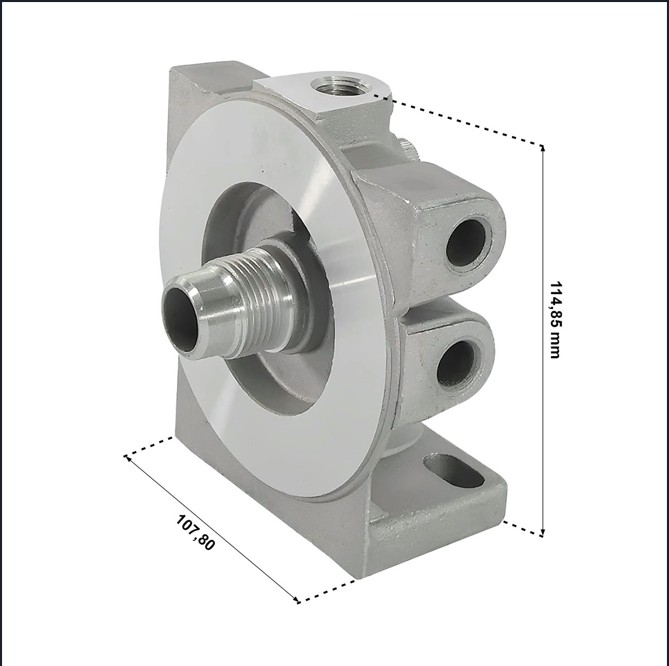
The filter head produced in an aluminium injection mold is a typical example of the pressure-resistant housing parts used in irrigation and filtration systems. For parts of this type, mold design addresses the runner and venting layout that reduces casting porosity together with the machining allowances left on the threaded and seal areas.
View projectFrequently asked questions
How long does it take to build an irrigation filter housing mold?
Are irrigation parts resistant to sunlight?
Can you build a mold for a threaded filter cap?
Should I choose a plastic or an aluminium filter housing?
Related services
Other industries
Quote
Get a quote for your industry
Send your part drawing or 3D model and we will propose material, mold concept and lead time.